How to turn one executive interview into a month of credible content
Executives are your most credible voice and your scarcest resource. One well-planned recording can feed four weeks of clips, posts and articles.
Key takeaways
- Buyers use thought leadership to judge suppliers, and many of the people who shape a deal rarely speak to your sales team.
- One prepared, well-recorded conversation of about an hour can supply a full episode, five clips, an article, newsletter items and a month of posts.
- Every clip must keep the speaker's meaning and context, and regulated firms must keep all marketing fair, clear and not misleading.
- Measure audience quality and business signals as well as views, and accept that attribution for executive content will always be partial.
Your chief executive is probably the most credible voice your company has, and the hardest person in the building to book. Many marketing teams know the pattern: a burst of executive content after a conference, then silence for three months.
The answer is not more of the executive’s time. It is more out of the time you already get. One well-planned, well-recorded conversation of about an hour can feed a full month of content. This guide shows how to plan it, record it, cut it up honestly and measure it.
Why executive content matters to B2B buyers
The most useful recent evidence is the 2025 B2B Thought Leadership Impact Report by Edelman and LinkedIn, which surveyed 1,934 business executives through LinkedIn in the US in March and April 2025[1]. It found that 64% of target decision-makers and 63% of “hidden” decision-makers spend more than an hour a week consuming thought leadership[1]. Hidden decision-makers sit in functions such as finance, legal, compliance and procurement: they help decide a purchase without being its main users.
Two findings stand out. First, 71% of hidden decision-makers say they have relatively little or no interaction with sales, yet 95% say strong thought leadership makes them more receptive to sales and marketing outreach[1]. Your content reaches people your sales team never meets. Second, 64% of them trust thought leadership more than marketing materials and product sheets when assessing a supplier’s capabilities[1].
The report also hints at a format: 65% of hidden decision-makers prefer a more human, less formal tone, and 57% favour quick takeaways over academic-style content[1]. A relaxed conversation, cut into short pieces, fits that brief.
Marketers are moving the same way. LinkedIn’s 2025 B2B Marketing Benchmark, based on an Ipsos survey of 1,500 B2B marketers in six countries, found that 78% already use video and 56% plan to increase their use in the next year[2]. Short-form social video was most often named as producing the highest return, by 41%[2].
A caution: these are self-reported surveys, and LinkedIn has an interest in the answer. Treat them as a signal about buyer habits, not proof that any one video will win a deal.
Why one long conversation is the efficient unit
Long-form conversation is now mainstream, and increasingly watched as well as heard. Edison Research’s Infinite Dial 2026 found that 58% of Americans aged 12 and over had consumed a podcast in the past month, and 57% had both listened to and watched one[3]. Edison calls podcasting “a dual-format medium now”[3]. YouTube reports 1 billion monthly active podcast viewers, and over 700 million hours of podcasts watched on living-room devices in October 2025, up from 400 million hours a year earlier[4]. Edison’s figures cover the US and YouTube’s are its own, but the direction is clear.
The practical case is simpler. An executive can give you 90 minutes once a month far more easily than 15 minutes every other day.
Plan the conversation before you book the room
Start with the buyer, not the executive. Pick one problem your clients face this quarter: a regulatory change, a cost squeeze, a shift in the market. Aim for insight, not reassurance. In the Edelman study, 86% of hidden decision-makers wanted ideas that challenge their assumptions[1].
Then plan backwards from the outputs:
- One theme, three or four questions. Each answer should work alone as a two-minute clip.
- A host who is not the executive, to draw out stories and push for specifics.
- A target length of 45 to 60 minutes, long enough for depth.
- A draft clip list, so you know which moments to listen for on the day.
Brief the speaker properly
Broadcasters offer a useful benchmark. The UK’s Ofcom Broadcasting Code says contributors should normally be told the nature and purpose of the programme, what kind of contribution is expected, including whether it will be edited, and the areas of questioning[5]. Give your executive the same courtesy: a one-page brief covering the theme, the questions, how the material will be cut and reused, and who approves what. Our guide to preparing your spokespeople covers the rehearsal that should follow.
For brokers, investment and wealth firms, involve compliance before the recording, not after the edit. Under MiFID II, all information addressed to clients or potential clients, including marketing communications, “shall be fair, clear and not misleading”[6].
Record it well
Sound comes first
If the budget stretches to one upgrade, make it sound. In two experiments, Newman and Schwarz played identical conference talks and radio interviews at high or low audio quality; people rated the research and the researcher less favourably when the audio was poor[7]. Give each speaker a dedicated microphone, choose a quiet room with soft furnishings, and record a backup track.
Cameras and light
Use at least three angles: a wide shot and a close shot of each speaker. That gives the editor cut points and room to reframe for vertical clips. Light faces evenly from the front and keep the background simple. In Wyzowl’s 2026 survey, 89% of consumers said video quality affects their trust in a brand, although the whole sample was only 266 people[8].
Turn one recording into many assets
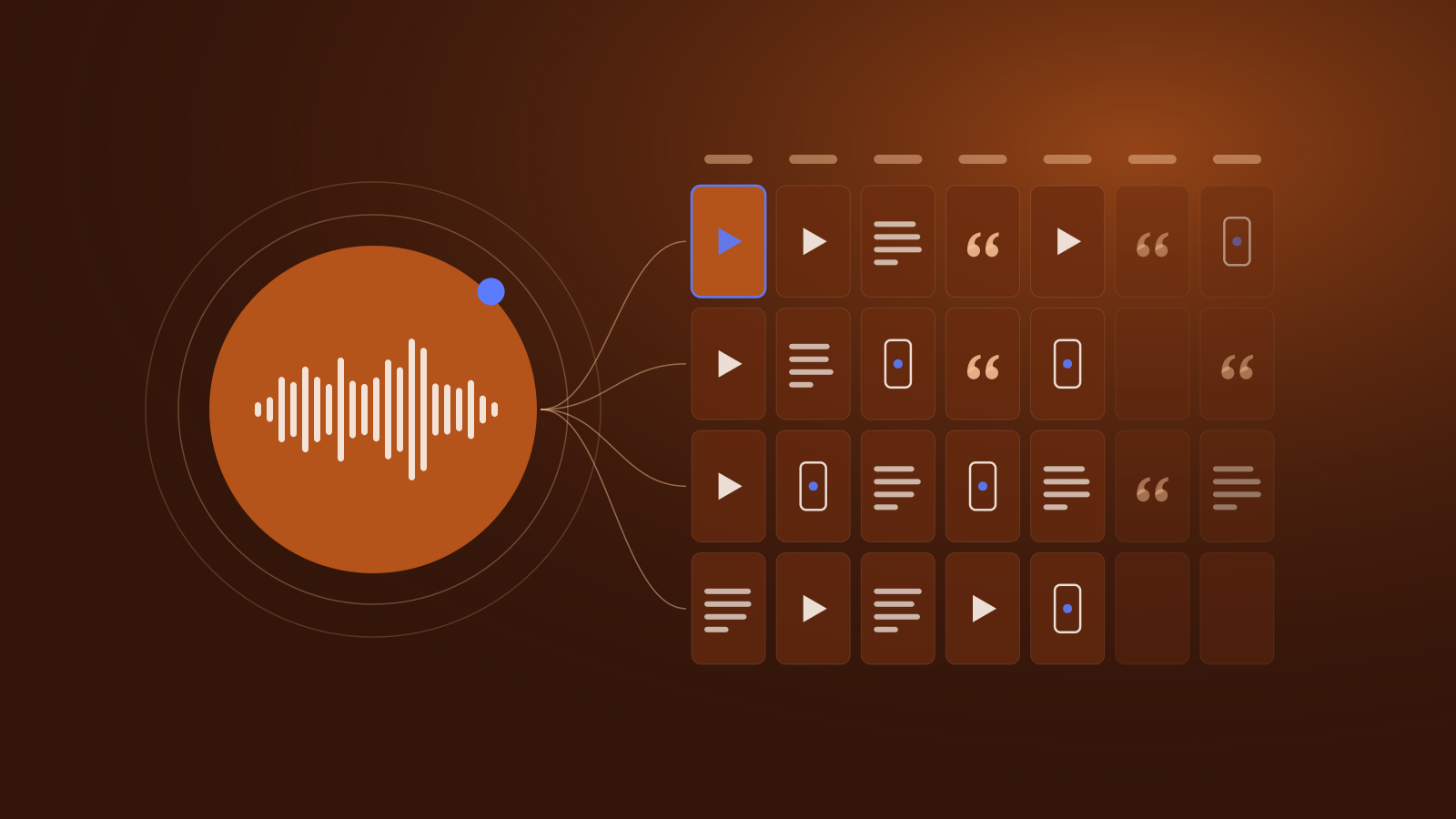
From a single hour you can reasonably expect:
- The full episode on YouTube and podcast platforms, with chapters.
- Five short clips and a trailer, each built around one idea. In Wyzowl’s survey, 71% said videos of 30 seconds to two minutes are most effective, and 63% of people said a short video is how they would most like to learn about a product or service[8].
- Two quote cards using the speaker’s exact words.
- A written article that develops the strongest argument and adds the context a conversation skips.
- Two newsletter items linking to the episode.
- Around ten LinkedIn posts, split between the executive’s profile and the company page.
Produce a clean, checked transcript first, so every written asset quotes the speaker exactly.
Distribute by platform, not by habit
Audiences find video on platforms, not company websites. The Reuters Institute’s Digital News Report 2026, covering 48 markets, found that 77% of people consume online news video each week, and that “the growth in online video consumption is all happening on third-party platforms”[9]. That is news data, not B2B data, but the lesson carries over: upload natively.
- YouTube carries everything from short clips to full-length programmes[9]. Square or vertical uploads of up to three minutes count as Shorts[10]. For pieces made for video from the start, see how to write a video script people watch to the end.
- LinkedIn accepts native video of up to 15 minutes[11], so post clips there and link to the full episode. Publish from the executive’s profile too, in line with Edelman’s advice to use a human tone and focus on professional feeds[1].
- Your website and newsletter hold the article, the embedded episode and the transcript.
Caption every clip so it works without sound.
Keep repurposing honest
Clipping is editing, and editing can mislead. Broadcast rules set a sensible standard: when a programme is edited, contributions “should be represented fairly”, and reusing material recorded for another purpose should not create unfairness[5].
In practice:
- Never join sentences from different answers to build a claim the speaker did not make.
- Keep caveats attached to the claims they qualify.
- Date market views, and retire clips once events overtake them.
- Link every clip to the full episode so anyone can check the context.
- Let the speaker approve the clip list. Regulated firms should run clips through the usual compliance review; MiFID II requires marketing communications to be “clearly identifiable as such”[6].
- Never use AI tools to change what someone said or how they said it.
Measure what matters
Most teams measure what is easiest. In Wyzowl’s survey, 67% of video marketers judged return by views and 63% by engagement, only 32% by bottom-line sales, and 17% were unsure how much they spend on video[8]. LinkedIn’s benchmark found engagement rate, views and click-through were the top video metrics, and named measurement gaps as a barrier[2].
A three-level scorecard is more useful:
- Attention. Watch time and completion for clips, plays for the episode, reading time for the article.
- Audience quality. Are comments and follows coming from your target firms and roles?
- Business signals. Newsletter sign-ups, enquiries that mention the content, and how often sales colleagues share it.
Be realistic about attribution. If 71% of hidden buyers have little or no contact with sales[1], their influence will not show up in a click path. Ask “where did you hear about us?” on enquiry forms and in first meetings. Evidence linking a specific video series to revenue is thin, so judge the programme over quarters, not posts.
A worked plan: one recording, four weeks
Assume one 60-minute conversation, recorded and edited a week before launch.
| Week | Long form | Short video | Posts and email |
|---|---|---|---|
| 1 | Full episode on YouTube and podcast feeds; episode page with transcript | Clip 1, the strongest idea, on the executive’s LinkedIn; trailer as a Short | Newsletter item launching the episode; company page post |
| 2 | None | Clips 2 and 3 | Quote card; executive post expanding one point |
| 3 | Article developing the main argument | Clip 4 | Second newsletter item; document post summarising the article |
| 4 | None | Clip 5, on the topic that drew most comments | Quote card; executive post answering a reader’s question; 30-day review |
The executive’s total commitment: a 30-minute briefing, a 90-minute recording slot and a 30-minute review of the clip list.
Your next steps
- Choose one buyer problem and one executive, and write three or four questions that could each stand alone.
- List every output and draft the four-week schedule before you book the recording.
- Send the speaker a one-page brief covering purpose, topics, editing, reuse and approval.
- Spend on sound first: one microphone per speaker, a quiet room, a backup recording.
- Write your clip rules: no stitched quotes, caveats kept, context linked, compliance checked.
- Pick one measure from each level of the scorecard and set a date for the 30-day review.
- Book the next conversation before the month ends, so the series keeps going.
Put it into practice
Want help turning an interview into a month of content?
Leave your details and we will get in touch to talk it through.
Sources 11
- 2025 B2B Thought Leadership Impact Report. Invisible Influence: Unlocking the Power of Hidden BuyersEdelman and LinkedIn
- 2025 B2B Marketing Benchmark: Trust Is the New KPILinkedIn, with research by Ipsos
- The Infinite Dial 2026Edison Research at SSRS, 2026-03-12
- How podcasts took over the living room in 2025YouTube Official Blog, 2025-12-18
- The Ofcom Broadcasting Code, Section seven: FairnessOfcom, 2023-03-16
- MiFID II (Directive 2014/65/EU), Article 24: General principles and information to clientsEuropean Securities and Markets Authority, Interactive Single Rulebook, 2014-05-15
- Good Sound, Good Research: How Audio Quality Influences Perceptions of the Research and ResearcherScience Communication (Newman and Schwarz), via ANU Research Portal, 2018-04-01
- Video Marketing Statistics 2026Wyzowl
- Digital News Report 2026: Executive summaryReuters Institute for the Study of Journalism, 2026-06-16
- Understand three-minute YouTube ShortsYouTube Help
- Video sharing troubleshootingLinkedIn Help
About the authors
 Co-authorSavvas AgathangelouEditor-in-Chief, Business & Economy Media Executive, Trust and Reputation Specialist
Savvas Agathangelou is a business and economy media executive and a trust and reputation specialist. He helps companies earn trust where it is now decided: with their audiences and with Google, ChatGPT, Claude and the other AI systems that increasingly describe them, starting from what a company can prove and how that evidence is published. He founded Cyprus Business Review, co-founded The Luxury Playbook and advised on Google Ads and communications on behalf of Google EMEA. A speaker at the Cyprus Diaspora Forum and a CYDIA Awards 2026 nominee in Marketing and Media, he is editor-in-chief of the Unita Media blog.
 Co-authorChrysanthos AgathangelouMarketing Specialist, Media, PR, AI Visibility and Strategy
Chrysanthos Agathangelou is Unita Media's marketing specialist for media, PR, AI visibility and strategy: the work of making a business easy to find, easy to quote and easy to trust. He came to it from performance marketing and analytics, where every campaign is judged on results, and brings the same discipline to reputation: a clear objective, the right placements and the numbers to show what worked. He has worked with brands across Cyprus and with trading and AI companies internationally, and co-writes Unita Media's practical guides on press, spokespeople, podcasts, video and visibility in AI search.
 Published by Unita Media
The platforms named in this article are part of the Unita Media group, and we built their websites.
For information only, not legal, financial or investment advice. Spotted something out of date? Tell us and we will correct it.